Faculty
教員紹介

Okubo Kunihiko
Civil Law
Professor
M.A. in Law (Kyoto University)

Main Research Areas
Civil Law (Particularly Contract, Tort and Restitution) and Methodology in Jurisprudence
Research Overview
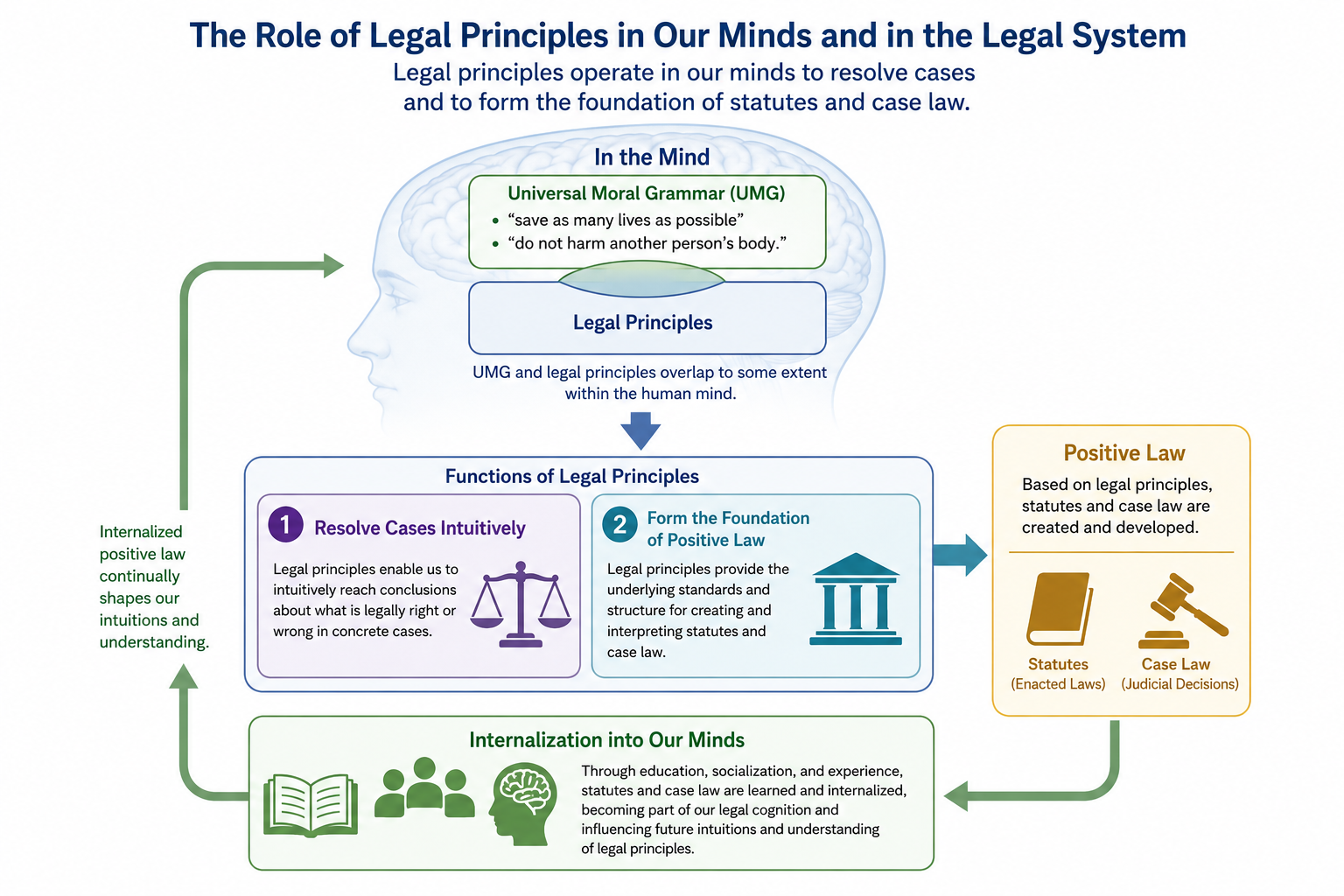
Lawyers resolve legal disputes on the premise of enacted statutes (positive law). In this process, they often reach conclusions intuitively, yet sometimes find it difficult to clearly articulate the underlying reasons. For some time now, I have been working to construct a model that explains this mechanism and clarifies the relationship between intuition and enacted law.
The reason conclusions are often reached intuitively is that the brain is equipped with highly specialized mechanisms for this purpose. Human thinking does not rely solely on language and logic. A classic example is how native speakers immediately sense that a sentence such as “What you bought?” (instead of “What did you buy?”) feels unnatural.
As Michael Gazzaniga has proposed, the brain consists of numerous modular processing systems, and intuitive judgments emerge from these modules. For instance, in the various versions of the trolley problem, people reach different conclusions depending on which module becomes dominant in a given situation—such as the one urging us to “save as many lives as possible” or the one insisting “do not harm another person’s body.”
These imperatives also serve as legal principles. According to Robert Alexy, legal principles are norms that direct certain values or states to be realized to the highest degree possible—what he calls “optimization commands.” The initial state of the value system that is shared almost universally among humans and is genetically grounded is known as Universal Moral Grammar. A strong candidate for one of its core components is the impulse—not merely a rational “requirement,” but a deep-seated desire—not to harm another person’s body. If this impulse forms part of the Universal Moral Grammar embedded in the brain, then certain legal principles are likely to be innately hardwired in human cognition as well.
Because legal principles function as optimization commands, they inevitably collide with one another. In the legal domain, such collisions are resolved through political decisions by legislators or courts. Legislators’ decisions take the form of statutes, while those of courts become precedents. However, to preserve the integrity of law, these decisions must not contain fundamental evaluative contradictions. In this sense, both legislators and courts operate within certain constraints.
Evaluative judgments embodied in statutes and precedents are internalized in the brain through learning. These learned evaluations then become an important foundation for intuitive legal judgments. In this way, intuition and enacted law are deeply and intricately interconnected.